And why “owning candidate supply” is becoming the only defensible advantage in 2026.
Most recruiting agencies think they have a talent pool.
They have an ATS.
They have thousands of profiles.
They have folders, tags, and “hot lists.”
But here’s the uncomfortable truth:
Most agencies don’t own a talent pool. They rent one.
They rent it from LinkedIn.
They rent it from job boards.
They rent it from inbound applicants who arrive only when the market feels like it.
That works—until it doesn’t.
In 2026, the agencies that win aren’t the ones who can search faster.
They’re the ones who can deliver candidates immediately because they’ve built something most agencies never build:
a proprietary candidate supply system.
The difference between “a database” and a real talent pool
An ATS database is a graveyard.
It’s full of old CVs, outdated titles, stale contact details, and “maybe later” candidates who have changed jobs twice since you last spoke.
A real talent pool is the opposite:
- continuously refreshed (weekly, not yearly)
- pre-segmented by niche (not generic tags)
- enriched with current signals (role changes, activity, skills, geography)
- scored for fit + likelihood to engage
- outreach-ready the moment a role appears
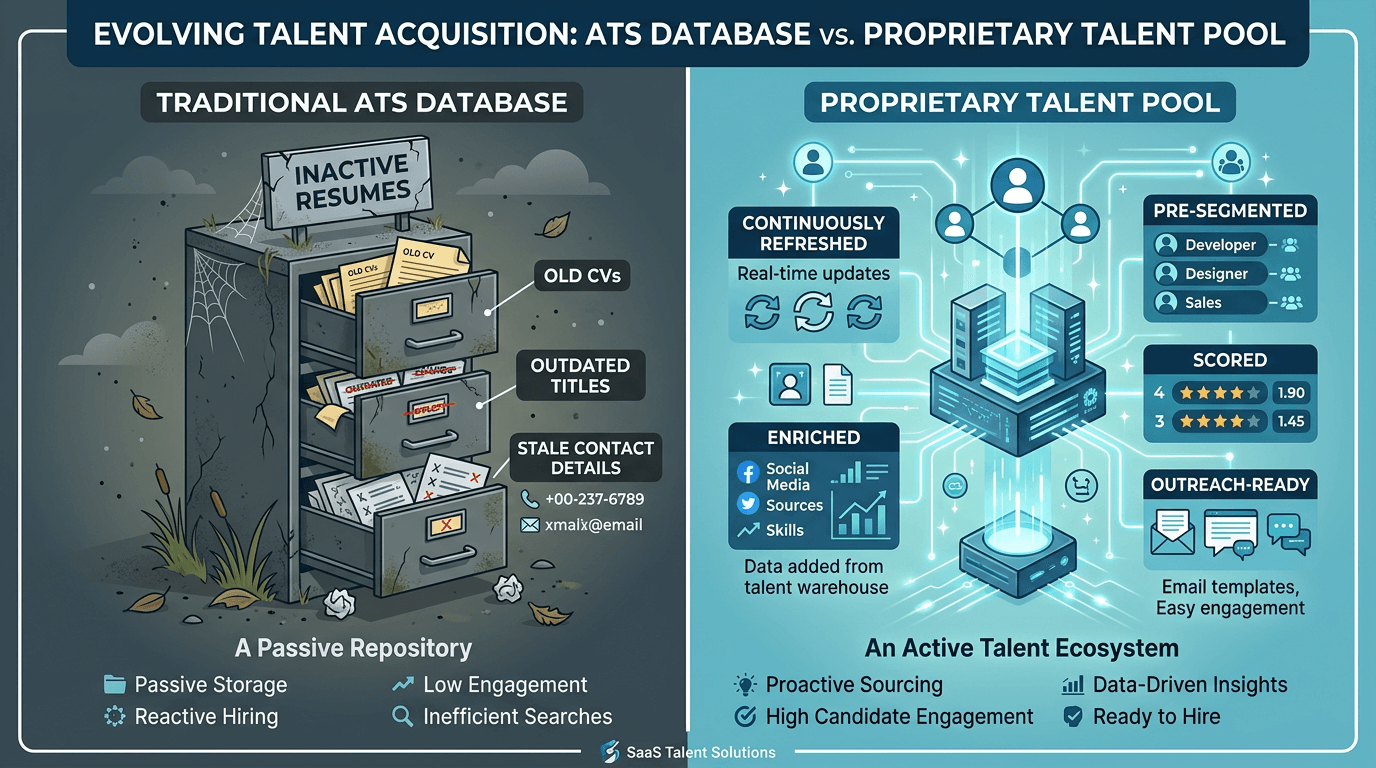
The shift from a static database to a living, proprietary talent pool.
If your recruiters still start each search with: “Let me see what LinkedIn shows…” — you don’t own supply.
You’re shopping at retail prices.
Why this is getting worse in 2026
Several shifts are colliding:
1) Direct sourcing is now default
Your clients can run the same searches.
They can message candidates.
They can run referral programs.
They can use AI sourcing tools.
When everyone has access to the same shelves, your advantage disappears.
2) Speed is becoming the product
Hiring managers are less patient.
Great candidates move faster.
The first agency that delivers credible profiles wins mindshare—and usually the fee.
3) Recruiter time is the real bottleneck
Even strong recruiters lose hours:
- searching
- copy/pasting profiles
- building lists manually
- updating records
- rewriting the same outreach
The market didn’t “get harder.”
The old process got too slow.
The new moat: owning candidate supply
In 2026, your defensibility is no longer “we have great recruiters.”
It’s:
we own a continuously updated pool of vetted candidates in a niche.
That turns recruiting into something closer to logistics:
- you don’t build a delivery company by re-finding roads every day
- you build routes, warehouses, and a system
Top agencies increasingly operate like they have a warehouse of candidates:
- niche inventory
- quality control
- rapid dispatch
That’s how some agencies fill roles in days—not weeks.
What a real talent pool looks like (practically)
A proprietary talent pool isn’t “one big list.”
It’s a set of micro-pools built around the roles you actually place.
Examples:
- Senior Rust Engineers in EU (FinTech / trading)
- Platform Engineers in DACH (Kubernetes-heavy)
- Data Engineers in the UK (Snowflake / dbt)
- AppSec Engineers in Europe (product security)
Each pool has:
- Sources (where candidates come from)
- Enrichment (how you keep profiles current)
- Scoring (how you rank and filter)
- Activation (how you message and convert)
- Maintenance (how it stays alive)
This is not a one-time project.
It’s a living asset.
“But we already have candidates” — the 3 brutal tests
If you want to know whether you truly own supply, run these tests:
Test #1: The 24-hour shortlist test
A good client calls with a role.
Can you deliver 8–12 credible, niche-matched candidates within 24 hours without doing fresh LinkedIn searches?
If not, you don’t own a pool.
Test #2: The freshness test
Pick 100 profiles in your ATS.
How many still have:
- current job title
- current company
- working email
- current location
If most are stale, it’s not a pool.
Test #3: The repeatability test
Can a new recruiter join your team and produce strong outreach in a niche within a week—because the system supports them?
If results depend entirely on the recruiter’s individual hustle, the asset doesn’t exist.
The “wow” part: this can now be automated
Here’s what changed recently:
You can now build a system that:
- continuously pulls candidates from multiple sources
- enriches profiles automatically
- keeps a pool updated weekly
- pre-screens candidates with AI
- ranks candidates per role automatically
- produces ready-to-send shortlists
Meaning:
Your recruiters spend less time searching and more time closing.
And that shifts your business from “time-for-fees” to “asset-based recruiting.”
How the Talent Pool Ramp-Up Sprint works
This is exactly what we implement in our Talent Pool Ramp-Up Sprint.
Goal: Build a living, proprietary talent pool in your niche that updates continuously.
In the sprint, we typically:
- define the niche + pool structure
- connect data sources (ATS, LinkedIn exports, Apollo, etc.)
- set up enrichment + refresh loops
- implement AI-based pre-screening + scoring
- build a simple dashboard that your team uses daily
The output is not “a tool.”
It’s a recruiting asset you own.
What happens after you own supply
Once you have a real talent pool, several things change fast:
- time-to-shortlist collapses
- recruiters stop wasting time on repetitive searches
- you can take on roles faster
- you look ridiculously responsive to clients
- you can even productize placements around niche pools
And most importantly:
You stop competing on speed of searching. You compete on speed of delivery.
Want to see what this could look like for your niche?
If you run a recruiting or staffing agency and you want to build a proprietary candidate pool that updates automatically, we’ll map it with you.
Book a call and we’ll:
- identify the best niche pool to build first
- show you what data sources you already have
- outline what the sprint would deliver in 2–3 weeks