You don’t lose placements because you can’t find candidates. You lose them because the pipeline stalls.
Most agency founders obsess over:
- sourcing volume
- BD activity
- recruiter performance
Those matter.
But in 2026, many agencies are leaking revenue in a place they rarely measure:
pipeline movement.
Not pipeline size.
Movement.
Because placements aren’t lost in dramatic moments.
They’re lost in slow ones.
A day of silence.
A delayed follow-up.
A hiring manager who “will get back tomorrow.”
A candidate who cools off.
This is the invisible bottleneck.
And it’s why many agencies feel like they’re working hard while results stay flat.
The uncomfortable truth: speed is a recruiting advantage
In 2026, speed is not just “nice service.”
Speed is competitive advantage.
Because:
- top candidates move fast
- clients talk to multiple agencies
- internal TA is competing with you
When the pipeline slows down, you don’t just lose time.
You lose trust.
And trust is what wins fees.
The bottleneck isn’t sourcing. It’s coordination
Most recruiting processes break at handoffs:
- recruiter → hiring manager
- recruiter → candidate
- hiring manager → interviewer panel
- agency → client HR
These handoffs create delays.
And delays compound.
The typical pattern looks like this:
- recruiter sends candidates
- client takes 3–7 days to respond
- candidate loses interest
- candidate accepts another offer
- role restarts
The recruiter “did the work.”
The process still failed.
Why you don’t notice the leakage
Pipeline leakage hides in plain sight because it doesn’t look like a problem.
It looks like:
- “We’re waiting.”
- “They’re busy.”
- “We’ll follow up tomorrow.”
- “Let’s give them a few days.”
But every “we’re waiting” is a probability drop.
And probability drops kill placements.
The 7 most common pipeline stall points
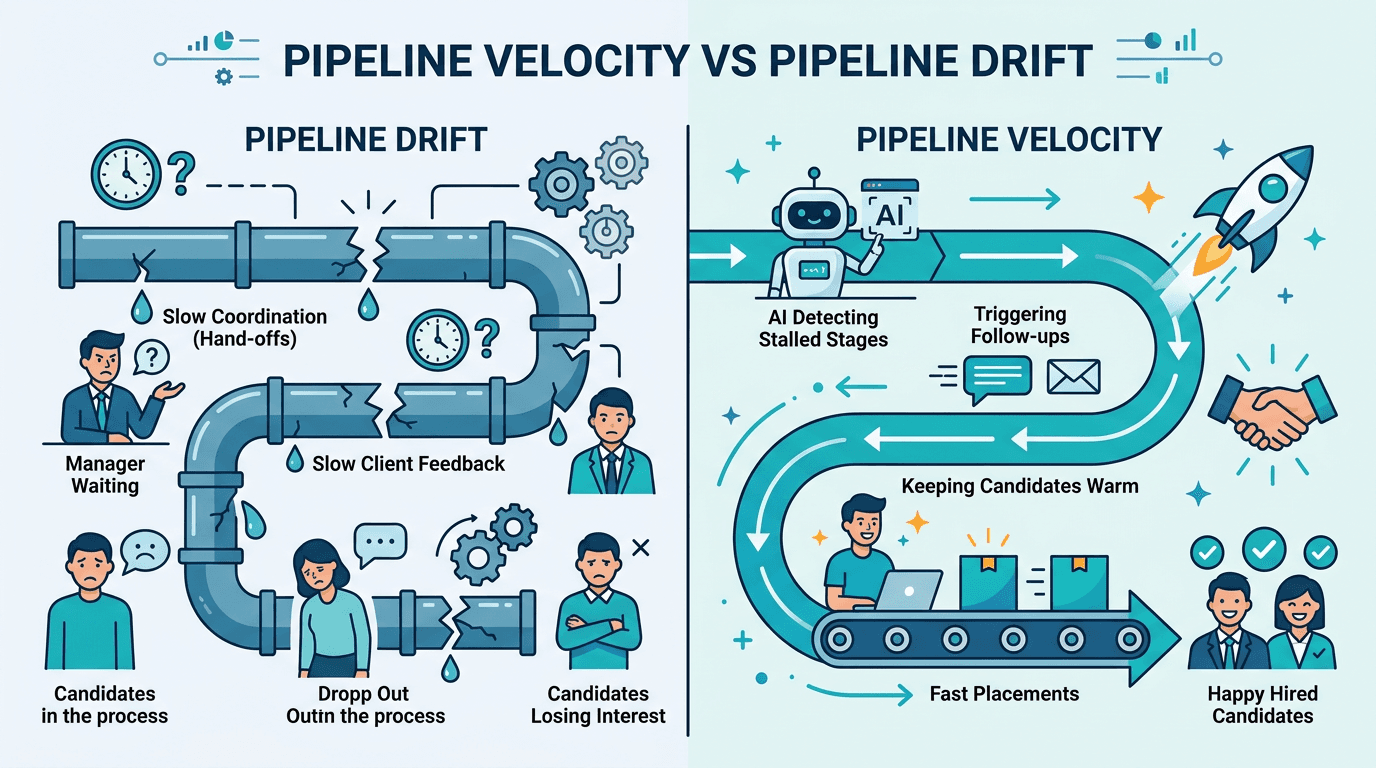
The difference between a leaky pipeline and continuous velocity.
If you want to find your invisible bottleneck, look for these:
1) Slow client feedback
The #1 killer.
Candidates don’t wait a week.
2) Interview scheduling delays
Even 48 hours can matter.
3) Missing next steps
No one clearly owns the next action.
4) Recruiters not following up consistently
Not because they’re lazy.
Because they’re busy.
5) Candidate experience gaps
Candidates don’t feel momentum.
They disengage.
6) Hiring manager churn / rescoping
The spec changes mid-process.
Candidates stall.
7) Poor pipeline visibility
Founders and managers don’t see where deals are stuck.
So nothing gets escalated.
The ‘wow’ insight: pipeline velocity is measurable
Agencies measure:
- number of candidates sourced
- number of messages sent
- number of interviews
But they often ignore the metric that determines placements:
time between steps.
Examples:
- time from shortlist → client feedback
- time from feedback → interview scheduled
- time from interview → decision
When you measure this, you see your real bottleneck.
And once you see it, you can fix it.
AI doesn’t replace recruiting. It prevents stalling.
Here’s where AI + automation creates leverage:
Not in “finding candidates.”
In preventing the pipeline from going cold.
AI workflows can:
- detect stalled stages automatically
- trigger follow-ups based on rules
- escalate when client feedback is overdue
- generate concise status updates for clients
- remind candidates and keep them warm
- summarize interviews and extract next steps
This turns pipeline velocity from “hope” into a system.
What a high-velocity agency looks like
High-velocity agencies don’t feel frantic.
They feel controlled.
Because they have:
- clear stage definitions
- next-action ownership
- automated reminders
- escalation rules
- pipeline dashboards
Recruiters spend less time chasing.
Clients feel more supported.
Candidates feel momentum.
That’s how you increase close rates without increasing headcount.
The objection: “But delays are the client’s fault”
Sometimes yes.
But here’s the truth:
Clients delay because:
- they’re busy
- they don’t feel urgency
- they don’t see the cost of delay
- they don’t get nudged consistently
A great agency manages client behavior.
Not by being annoying.
By being systematic:
- short updates
- clear deadlines
- escalation paths
- visible pipeline status
You can’t control the client.
But you can influence them.
How we fix this in the Recruiting Back-Office Sprint
This is a core focus of the Recruiting Back-Office Sprint.
Outcome:
A recruiting ops system that reduces pipeline stalling and increases placement probability.
In the sprint, we typically:
- map your stages and handoffs
- identify stall points and leakage patterns
- implement automations for:
- stalled-stage detection
- follow-ups to candidates and hiring managers
- interview scheduling workflows
- automatic status updates
- escalation rules when feedback is overdue
- build a simple dashboard for pipeline velocity
The goal is not “more automation.”
The goal is more placements.
Quick self-check: do you have pipeline velocity or pipeline drift?
Answer these:
- Do you know your average time from shortlist to feedback?
- Do you know which hiring managers create the most delays?
- Do candidates ever go quiet because nothing happened for days?
- Do recruiters spend a lot of time chasing updates?
If yes, your bottleneck isn’t sourcing.
It’s pipeline movement.
Want to find your invisible bottleneck?
If you run a recruiting/staffing agency and want to increase close rates without adding headcount, we can help you diagnose and fix the stall points.
Book a call and we’ll:
- map your recruiting workflow
- identify the top 3 delay points
- outline what the Recruiting Back-Office Sprint would automate first