Stop guessing who’s hiring. Start watching what happens before hiring starts.
Most recruiting agencies do bizdev like this:
- pick an industry
- build a list
- send outreach
- hope someone happens to be hiring
It’s understandable.
But it’s also backward.
Because in 2026, you don’t need to guess.
Hiring leaves footprints before the job post exists.
The agencies that grow right now are not “working harder.”
They’re doing something smarter:
they build a hiring radar using signals that predict hiring 30–120 days in advance.
That’s the “wow” shift.
And it’s very real.
Why job posts are the end of the story
When you see a job post, one of two things is true:
- the company is early and organized
- the company is late and already feeling pain
Either way, job posts are reactive.
By the time the job is public:
- internal TA is already working it
- multiple agencies may already be engaged
- candidates are already being contacted
If your BD strategy starts at “find job posts,” you’re always late.
Signal-driven agencies aim earlier:
What happens before the job exists?
Signals are just “events that change hiring probability”
A hiring signal is any observable event that makes it more likely a company will hire.
The magic is not the word “signal.”
The magic is what it does to your conversion math.
Instead of prospecting 500 companies,
you focus on the 30 where hiring probability just spiked.
That makes your outreach:
- more relevant
- more timely
- less spammy
And founders notice.
The 9 signals that predict hiring before it’s public
Below are signals that frequently precede hiring waves.
None of them guarantee a contract.
But together, they turn BD from “spray and pray” into selection.
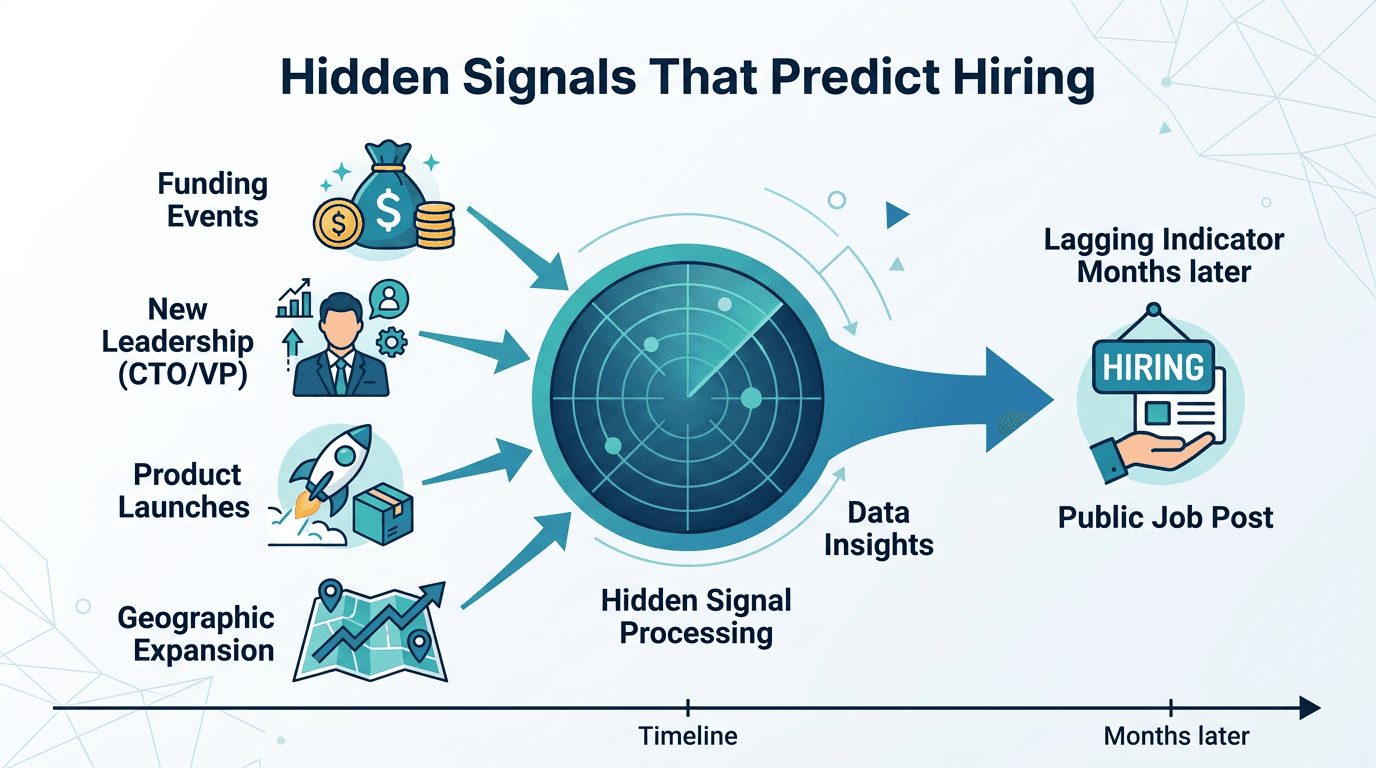
Predictive signals occur months before the job post goes live.
1) Funding events (fresh runway)
New funding often comes with growth expectations.
Even in cautious markets, investors expect movement.
Recruiting need follows.
What to watch:
- seed → Series A transitions
- Series A/B announcements
- debt financing for expansion
2) New CTO / VP Engineering / Head of Talent
Leadership hires often trigger:
- team rebuilds
- new org design
- new hiring priorities
A new CTO frequently means:
- platform modernization
- hiring senior engineers
- replacing underperforming roles
3) New product launch or major roadmap shift
When product scope changes, capacity follows.
Signals:
- public launch announcements
- “we’re entering X market” messaging
- large feature roadmap communications
4) Geographic expansion
New office, new country, new region.
This often creates urgent hiring needs—especially leadership and first hires.
5) Rapid LinkedIn headcount growth
Headcount growth curves can be spotted.
A rising trend in the last 30–90 days is a strong indicator.
6) Hiring manager churn
If key leaders leave and replacements arrive, roles often open quietly.
7) Layoffs (yes, layoffs)
This sounds counterintuitive.
But layoffs can trigger targeted hiring in:
- revenue-critical teams
- replacement roles
- transformation initiatives
Layoffs also create:
- candidate supply surges
- urgency to “rebuild smarter”
8) Tech stack changes
Signals like:
- cloud migration announcements
- new security compliance requirements
- platform re-architecture
…often precede hiring for niche skills.
9) New strategic partnerships
Partner integrations and major deals often require:
- delivery capacity
- new roles
- domain expertise
The ‘wow’ moment: signals stack, and probability explodes
One signal is interesting.
Three signals at once is a flashing red light.
Example:
- company raises Series A
- hires a new VP Engineering
- posts two platform roles quietly
That’s a company that will likely need help.
Your outreach becomes obvious, not annoying.
What signal-driven outreach looks like (and why it works)
Generic outreach:
“We help companies hire great engineers.”
Signal-driven outreach:
“Noticed you’ve just hired a new CTO and announced expansion into DACH. When that happens, internal TA usually gets overloaded. We can deliver a shortlist of [role] candidates quickly if you’re scaling that team.”
Same service.
Completely different relevance.
How to operationalize this (without turning into a data company)
Founders often ask:
“Ok, but who has time to track all this?”
Exactly.
You don’t do it manually.
You build a simple workflow:
- pick your niche + region
- define a small set of signals that matter
- pull data from a few sources
- refresh weekly or daily
- rank companies by intent
- feed the list into your BD process
This is what turns hiring intelligence into a usable weapon.
How we implement this in the Hiring Intelligence BizDev Sprint
This is exactly what we build in our Hiring Intelligence BizDev Sprint.
Outcome:
A “Hiring Radar” that identifies companies likely to hire soon, ranked by intent.
In the sprint, we typically:
- define your ICP (niche + geography)
- select 6–10 signals that matter in your market
- connect the relevant data sources
- automate refresh cycles (daily/weekly)
- generate a prioritized target list
- optionally add AI-generated “talking points” per company
The goal is not more outreach.
The goal is fewer, better conversations.
What changes when you operate with signals
Agencies that implement hiring intelligence usually see:
- higher reply rates (because timing is right)
- shorter sales cycles (need is real now)
- better client conversations (because you sound informed)
- less BD burnout (because the list is smaller)
And because the system runs continuously:
You don’t “do bizdev.”
You operate a pipeline.
Want to build a Hiring Radar for your niche?
If you run a recruiting/staffing agency and want to know who will hire next before they post, this is the sprint.
Book a call and we’ll:
- pick the best signals for your niche
- outline the data sources you already have
- map what the Hiring Intelligence BizDev Sprint would deliver in a few weeks