Cold outreach isn’t dead. Blind outreach is.
Most recruiting agencies don’t have a bizdev problem.
They have a targeting problem.
They do a huge amount of activity—emails, LinkedIn messages, calls—and still feel like:
- reply rates are low
- calls don’t convert
- sales cycles drag
- “good logos” don’t buy
So they tweak:
- messaging
- sequences
- offers
- pricing
Those things matter.
But if you’re messaging the wrong companies at the wrong time, your BD engine is fundamentally mis-aimed.
In 2026, agencies that win are shifting from:
cold prospecting → intent targeting
And the mechanism behind that shift is simple:
data can tell you which companies are likely to need recruiters—before they say it out loud.
Cold prospecting is just “guessing with effort”
Let’s define terms.
Cold prospecting
You pick a list of companies that might hire.
You message them.
You hope timing aligns.
Cold prospecting is not “wrong.”
It’s just statistically brutal.
Because most companies are not buying recruiting services this month.
So your outreach becomes:
- a lottery ticket
- disguised as a sales system
The better model: intent targeting
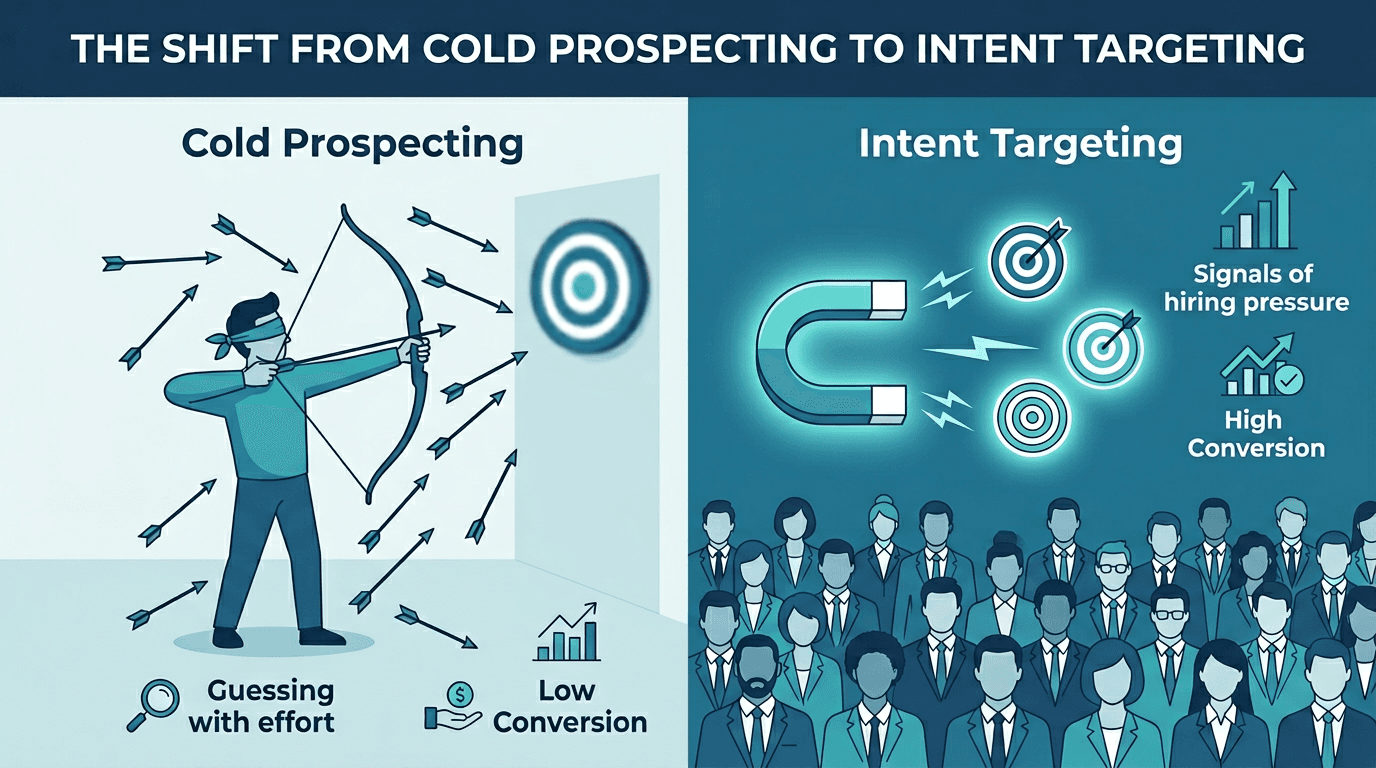
The shift from blind outreach to precision targeting based on hiring intent.
Intent targeting means:
You don’t message companies because they match your ICP.
You message companies because:
your ICP is showing signals of hiring pressure.
It’s the difference between:
- marketing to “people who might need a gym”
- marketing to “people who just searched ‘how to lose 10kg’ and bought running shoes”
Same audience.
Completely different readiness.
The 3 categories your target list contains
Every “ideal client list” contains three groups:
Group 1: Not hiring
They’re a nice logo.
But they won’t buy.
Group 2: Hiring, but not in pain
Roles are open, but internal TA is handling it.
Or timelines are flexible.
Group 3: Hiring + under pressure
The hiring manager needs speed.
Internal TA is overloaded.
The role is stuck.
The business needs delivery.
Only Group 3 reliably converts.
Most agencies spend most of their time on Groups 1 and 2.
That’s why BD feels exhausting.
What data can actually tell you (practically)
Founders sometimes imagine “data” means complicated dashboards and data scientists.
In reality, recruiting BD needs a very small set of answers:
- Which companies are most likely to hire in my niche in the next 30–90 days?
- Which companies are showing hiring pressure right now?
- What changed recently that makes them a good target?
Once you have those answers, your outreach becomes timely.
And timely outreach converts.
What signals indicate “needs recruiters” (not just “is hiring”)
This is the subtle part.
Many companies are hiring.
Fewer companies are hiring and will pay for help.
Signals that often indicate external recruiter need:
- rapid hiring across multiple roles at once
- leadership changes + team rebuild
- new product line requiring niche skills
- expansion into new geography
- repeated job reposting (role is stuck)
- internal TA headcount not keeping up
- high seniority roles where sourcing is hard
The goal is not “find hiring companies.”
The goal is:
find companies where hiring pain is emerging.
The ‘wow’ move: build a “priority list” that refreshes automatically
Imagine your BD team starts the week with a ranked list:
Top 25 targets this week (ranked by intent)
And each company comes with:
- the signal(s) that triggered it
- a short context summary
- suggested outreach angle
Now BD becomes:
- smaller lists
- higher relevance
- better conversations
Founders tend to have this moment:
“We can stop grinding and start selecting.”
Why this changes your agency economics
Signal-driven BD improves three core metrics:
1) Reply rate
Because your message has context and timing.
2) Call-to-client conversion
Because the need already exists.
3) Sales cycle length
Because you’re not trying to “educate” a company into needing recruiting.
You’re catching them when they already feel it.
The result is fewer meetings, more revenue.
A concrete example outreach structure
Here’s a simple pattern that works well for signal-driven outreach:
- Trigger (what you noticed)
- Implication (why it usually creates hiring pressure)
- Offer (what you can do, specifically)
- Soft CTA (ask a small question)
Example:
“Saw you hired a new VP Engineering and posted two platform roles. Usually this is when internal TA gets overloaded and hiring managers want speed. We can deliver a shortlist of [role] candidates in 48 hours from our niche pool. Is that role urgent right now?”
That’s not spam.
That’s informed relevance.
How we implement this in the Hiring Intelligence BizDev Sprint
This is what the Hiring Intelligence BizDev Sprint is designed for.
Outcome:
A Hiring Radar that identifies, ranks, and explains which companies are most likely to need recruiting support—continuously.
In the sprint, we typically:
- define your niche ICP + target regions
- select the best 6–10 hiring signals for your market
- connect data sources (job posts, funding, headcount, leadership changes, etc.)
- automate daily/weekly refresh cycles
- generate a ranked “priority list” of targets
- optionally add AI-generated summaries + outreach angles
This turns bizdev into a repeatable system.
Not a heroic effort.
Quick self-check: are you blind prospecting or intent targeting?
Answer these:
- Do you know which 25 companies are most likely to hire in your niche in the next 60 days?
- Can your team generate and refresh that list without manual research?
- Do your messages reference a real trigger, not generic capability?
If not, you’re still running blind prospecting.
And it’s getting more expensive every year.
Want your own Hiring Radar?
If you run a recruiting/staffing agency and want BD to be predictable instead of random, let’s map your signals.
On a call we’ll:
- choose the best triggers for your niche
- outline what data sources you can use immediately
- show what the Hiring Intelligence BizDev Sprint would deliver