In 2026, the bottleneck in recruiting isn’t sourcing. It’s admin.
If you run a recruiting or staffing agency, your biggest cost isn’t software.
It’s time.
Recruiter time is the unit economics of your business.
And here’s the uncomfortable truth most founders avoid:
A huge chunk of recruiter time is spent on work that doesn’t create placements.
Not relationship-building.
Not persuasion.
Not closing.
Admin.
In 2026, that’s no longer “the cost of doing business.”
It’s a competitive disadvantage.
Because AI can do a surprising amount of this work—reliably.
The real daily workload of a recruiter (the part nobody advertises)
Most recruiter calendars aren’t full of high-value conversations.
They’re full of:
- updating the ATS
- writing notes
- formatting CVs
- sending follow-ups
- scheduling interviews
- chasing hiring managers
- answering the same questions in email threads
- copying data between systems
- status reporting
These tasks are necessary.
But they’re not what clients pay for.
And they quietly consume a shocking amount of time.
Why this got worse in 2026
Three forces collided:
1) More systems, more fragmentation
ATS, CRM, email, LinkedIn, calendars, forms, Slack, spreadsheets.
Every new tool adds context switching.
2) Candidate expectations increased
Candidates expect faster feedback, clearer timelines, better communication.
That means more follow-ups, more coordination.
3) Clients want speed + visibility
Hiring managers want updates.
Founders want pipeline visibility.
So recruiters spend even more time reporting—not recruiting.
The ‘wow’ shift: AI turns admin work into background automation
Most agencies hear “AI” and imagine:
- writing messages
- replacing recruiters
- magic sourcing
That’s not where the biggest leverage is.
The highest ROI is boring:
AI + automation removes the administrative drag from recruiting ops.
Meaning:
- recruiters stop acting like data-entry clerks
- pipeline moves faster
- candidates don’t fall through cracks
And you get more placements without hiring more people.
What AI can reliably do today (for recruiting ops)
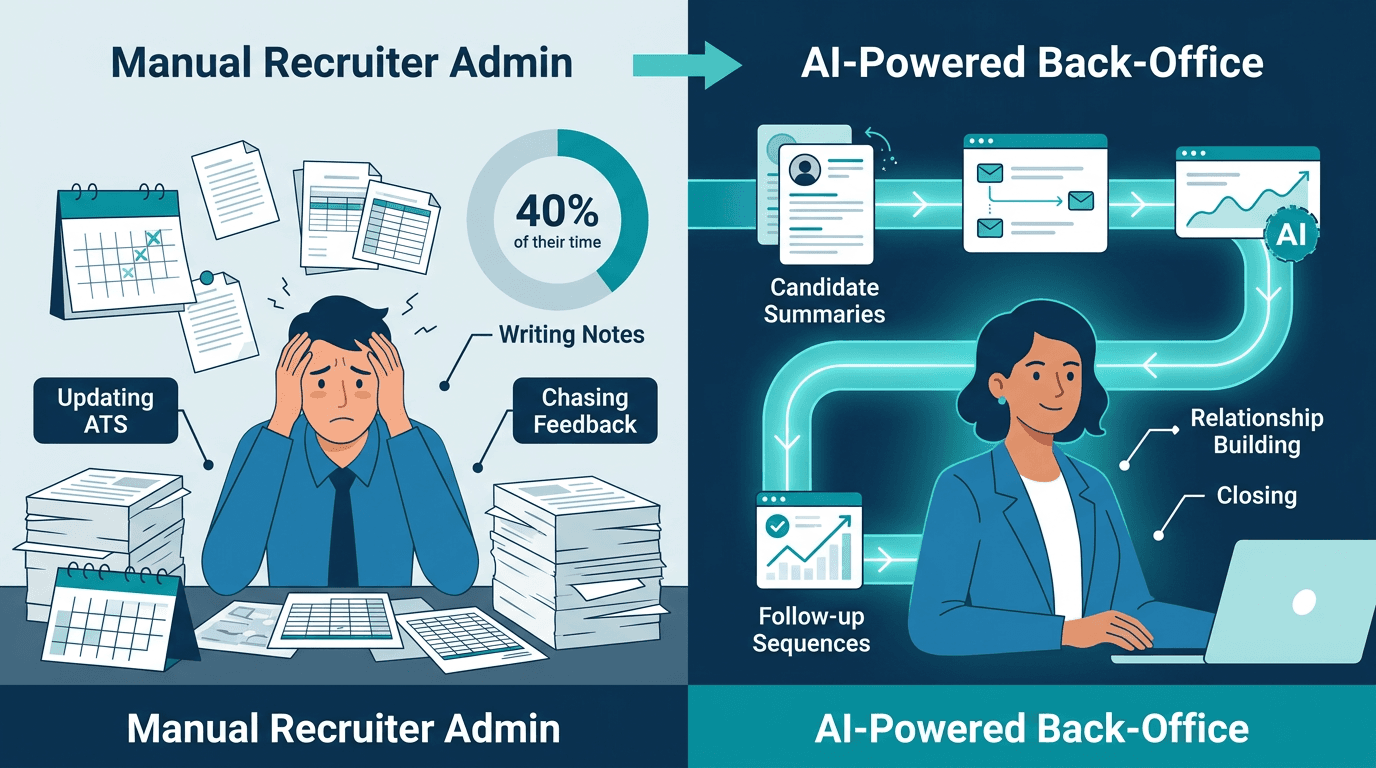
The shift from manual admin drag to an automated, AI-powered back-office.
Let’s keep it practical.
Here are areas where AI + automation already works well:
1) Candidate summarization
Turn a CV + LinkedIn profile into:
- a structured summary
- strengths / risks
- key skills
- role fit
2) Interview notes and next-step generation
After a call:
- summarize conversation
- extract requirements
- generate next steps
- create ATS notes automatically
3) Follow-up sequences
Candidates and hiring managers need nudges.
Automate:
- candidate follow-ups
- interview reminders
- “are we still on track?” check-ins
- feedback requests
4) Status reporting
Instead of recruiters writing updates:
- generate weekly pipeline summaries
- highlight stalled candidates
- flag missing feedback
5) Document handling
Automate the annoying tasks:
- CV formatting
- anonymization
- creating submission packages
6) Scheduling coordination
Auto-propose times.
Auto-confirm.
Auto-reschedule.
This alone saves hours.
The hidden revenue leak: pipeline leakage
Founders often focus on sourcing and BD.
But many agencies lose placements because of small operational failures:
- candidate not followed up
- feedback not chased
- scheduling delays
- stale pipeline status
These are not “small issues.”
They compound.
A 2-day delay in feedback often means you lose the best candidate.
AI doesn’t “recruit.”
But it can enforce discipline:
- reminders
- alerts
- escalations
- next actions
That reduces leakage.
And leakage reduction = more placements.
The new role of recruiters: relationship closers, not admin workers
When admin is automated, recruiters spend more time on:
- high-quality candidate conversations
- persuasion and negotiation
- stakeholder management
- closing candidates
- closing clients
This is where humans still dominate.
The goal is not “replace recruiters.”
The goal is:
let recruiters recruit.
The objection: “We already have an ATS”
An ATS stores data.
It doesn’t:
- keep the pipeline moving
- chase feedback
- summarize calls
- generate updates
- prevent candidates from falling through
That’s why agencies end up building manual processes around the ATS.
AI + automation is how you stop running your agency on human duct tape.
How we implement this in the Recruiting Back-Office Sprint
This is what the Recruiting Back-Office Sprint is for.
Outcome:
A set of automations + AI workflows that remove operational drag and increase recruiter throughput.
In the sprint, we typically:
- map your current recruiting workflow end-to-end
- identify the top time sinks + leakage points
- implement automations for:
- ATS notes and summaries
- follow-ups and reminders
- pipeline alerts
- weekly status reporting
- scheduling coordination
- integrate with your existing stack (ATS/CRM/email/calendar)
The result is not “AI for AI’s sake.”
The result is:
- faster movement
- fewer missed steps
- more recruiter capacity
A quick self-check: do you have admin drag or a recruiting machine?
Answer these:
- Do candidates ever go 3–5 days without feedback because someone forgot?
- Do recruiters spend hours per week writing updates and notes?
- Do hiring managers complain about “lack of visibility”?
- Does your team manually copy data between systems?
If yes, you have a back-office opportunity.
And in 2026, operational leverage is a growth strategy.
Want to see where your agency is losing time?
If you run a recruiting/staffing agency and want to increase placements without increasing headcount, this is a good conversation.
Book a call and we’ll:
- identify your top 3 operational bottlenecks
- estimate where time is being lost
- outline what the Recruiting Back-Office Sprint would automate first