Not by working harder. By removing the drag that used to require a team.
For years, agency scaling had a simple formula:
More roles → hire more recruiters.
It worked.
Until it didn’t.
In 2026, agencies are hitting a new ceiling:
- candidates expect faster responses
- clients want more visibility
- tools are fragmented
- recruiters are drowning in admin
Founders feel it as “busy teams, flat results.”
And then they see a strange thing happening in the market:
Some agencies are increasing placements without increasing headcount.
How?
They’ve changed what a recruiter is allowed to spend time on.
They turned recruiting into a system.
The myth: “Recruiting is inherently manual”
Recruiting will always have human work.
But the amount of manual admin we accepted as normal was never sacred.
It was just… tradition.
Historically, to run a high-volume agency you needed:
- recruiters to source
- coordinators to schedule
- admins to format CVs
- someone to write updates
- someone to chase feedback
That’s why scaling meant adding people.
AI + automation breaks that equation.
What actually consumes recruiter capacity
If you want to understand the “5x recruiter,” look at what disappears.
The capacity killer isn’t one huge task.
It’s 100 small ones:
- copy/paste candidate info into ATS
- rewrite a candidate summary
- chase a hiring manager for feedback
- send reminders
- format submissions
- update spreadsheets
- schedule interviews
- write weekly status reports
Individually small.
Collectively massive.
When those tasks are automated, recruiter output changes dramatically.
The ‘wow’ shift: recruiter throughput is now a design choice
In 2026, a recruiter’s productivity depends less on personal hustle and more on:
- workflow design
- automation coverage
- system integration
- data quality
This is why two agencies with equally talented recruiters can produce wildly different results.
One is running on human duct tape.
The other is running on a recruiting operating system.
What the “5x recruiter” actually does all day
Here’s the key idea:
The 5x recruiter is not a superhero.
They’re a recruiter whose time is reserved for high-leverage work:
- candidate conversations
- stakeholder alignment
- persuasion and negotiation
- closing candidates
- closing clients
And everything else is handled by workflows.
The 5 layers of automation that create 5x output
You don’t need 50 automations.
You need the right few in the right places.
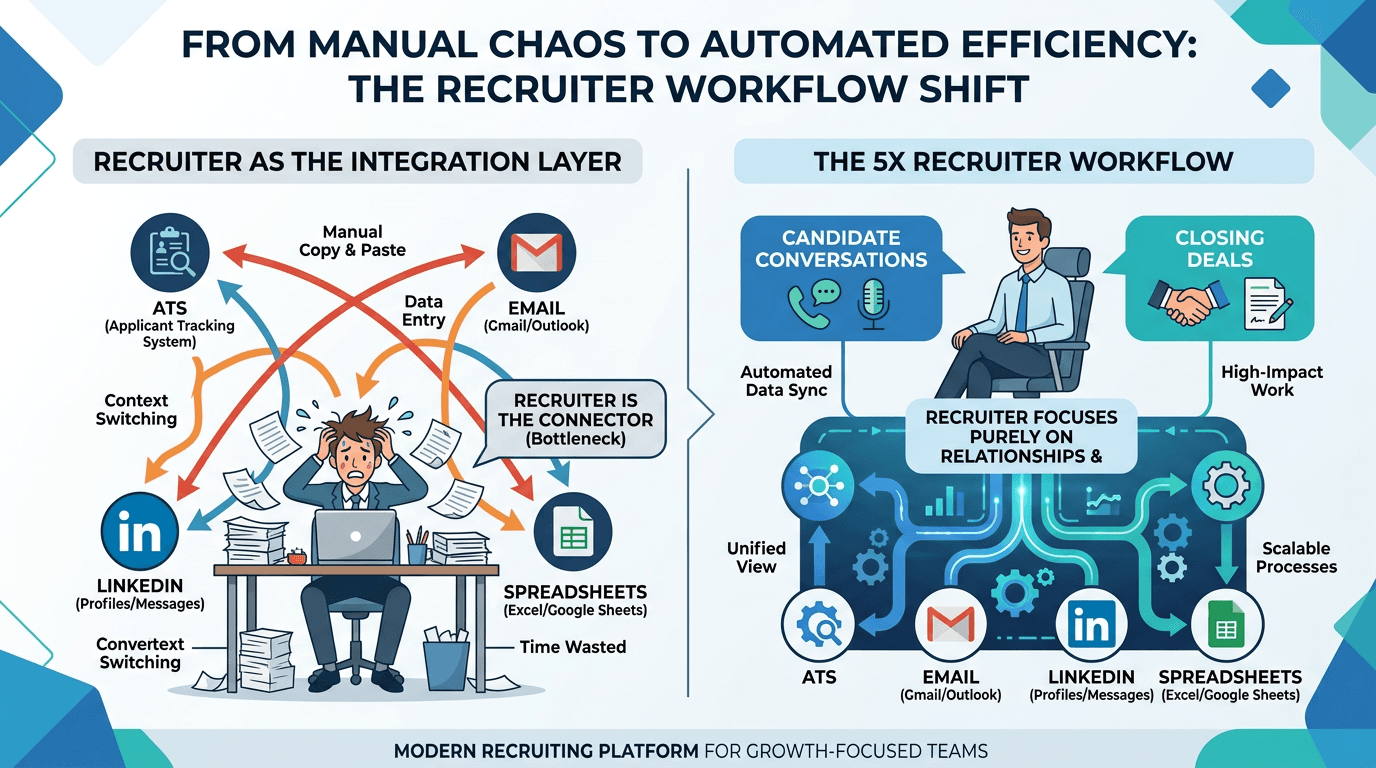
From human duct-tape to an automated, high-leverage workflow.
Layer 1: Capture and structure information
Instead of notes living in someone’s head:
- calls are summarized
- requirements are extracted
- key fields are structured
- ATS entries are auto-created
Layer 2: Generate candidate assets instantly
For each candidate, the system can produce:
- a clean submission summary
- strengths/risks
- role fit explanation
- tailored talking points
Layer 3: Follow-up and reminders (the pipeline never goes silent)
Automate:
- candidate follow-ups
- hiring manager nudges
- feedback chasers
- interview reminders
This alone reduces leakage.
Layer 4: Scheduling coordination
Auto-propose times.
Auto-confirm.
Auto-reschedule.
Scheduling is a hidden time sink.
Layer 5: Pipeline visibility and escalation
When the system detects stalling:
- it flags the stage
- escalates internally
- produces a status update
Founders see bottlenecks before placements die.
The most important benefit: fewer dropped balls
When teams are busy, small failures multiply:
- candidate goes cold
- feedback is late
- client loses trust
- competitor wins
A “5x” system isn’t just faster.
It’s more reliable.
Reliability increases close rates.
And close rate improvements are worth more than any sourcing trick.
“But we already use tools” — why that’s not enough
Most agencies have:
- ATS
- calendar
- maybe automation tools
But the pain persists.
Because the problem isn’t tools.
The problem is handoffs between tools.
Recruiters become the integration layer.
They copy information from one system to another.
That’s where time dies.
The 5x agency makes the systems talk.
The real outcome: growth without headcount
When recruiting operations are automated:
- recruiters handle more roles
- managers get visibility
- clients get faster updates
- candidates get better experience
You can grow output without growing payroll.
That’s not a productivity hack.
That’s a business model shift.
How we implement this in the Recruiting Back-Office Sprint
This is exactly what we build in the Recruiting Back-Office Sprint.
Outcome:
An integrated set of workflows that removes admin drag, prevents pipeline stalling, and increases recruiter throughput.
In the sprint, we typically:
- map your end-to-end recruiting process
- identify the top time sinks and leakage points
- implement the 5 high-impact automation layers:
- capture + structured notes
- candidate summaries and submissions
- follow-ups and reminders
- scheduling coordination
- pipeline visibility + escalation
- integrate with your ATS/CRM, email, and calendar
The goal is not “more tools.”
The goal is one recruiter producing output that previously required a small team.
Quick self-check: do you have recruiter leverage or recruiter load?
Answer these:
- Do recruiters spend hours per week updating systems?
- Do candidates or clients wait days because someone forgot to follow up?
- Do managers lack visibility on what’s stuck?
- Does scheduling consume a ridiculous amount of time?
If yes, you don’t have a recruiting performance problem.
You have an operations leverage problem.
Want to see where you can get 5x leverage first?
Book a call and we’ll:
- identify your top 3 time sinks
- map where pipeline leakage is happening
- outline what the Recruiting Back-Office Sprint would automate first