Spoiler: they don’t “source faster.” They build inventory before the job exists.
A client calls on Monday morning:
“We need a Senior [Role] ASAP. Can you help?”
Most agencies say yes.
Then they do what everyone does:
- open LinkedIn
- run searches
- build a list
- start outreach
- wait for replies
Days pass.
By the time the agency sends a shortlist, the client already spoke to three other agencies, pinged their internal recruiter, and posted the job.
Now compare that to the agencies that consistently deliver candidates within 24–48 hours.
Their secret is not hustle.
It’s a simple operating principle:
They don’t start with search. They start with inventory.
Search vs. inventory (and why this matters now)
Search is what you do when you don’t have supply.
Inventory is what you build when you plan to win.
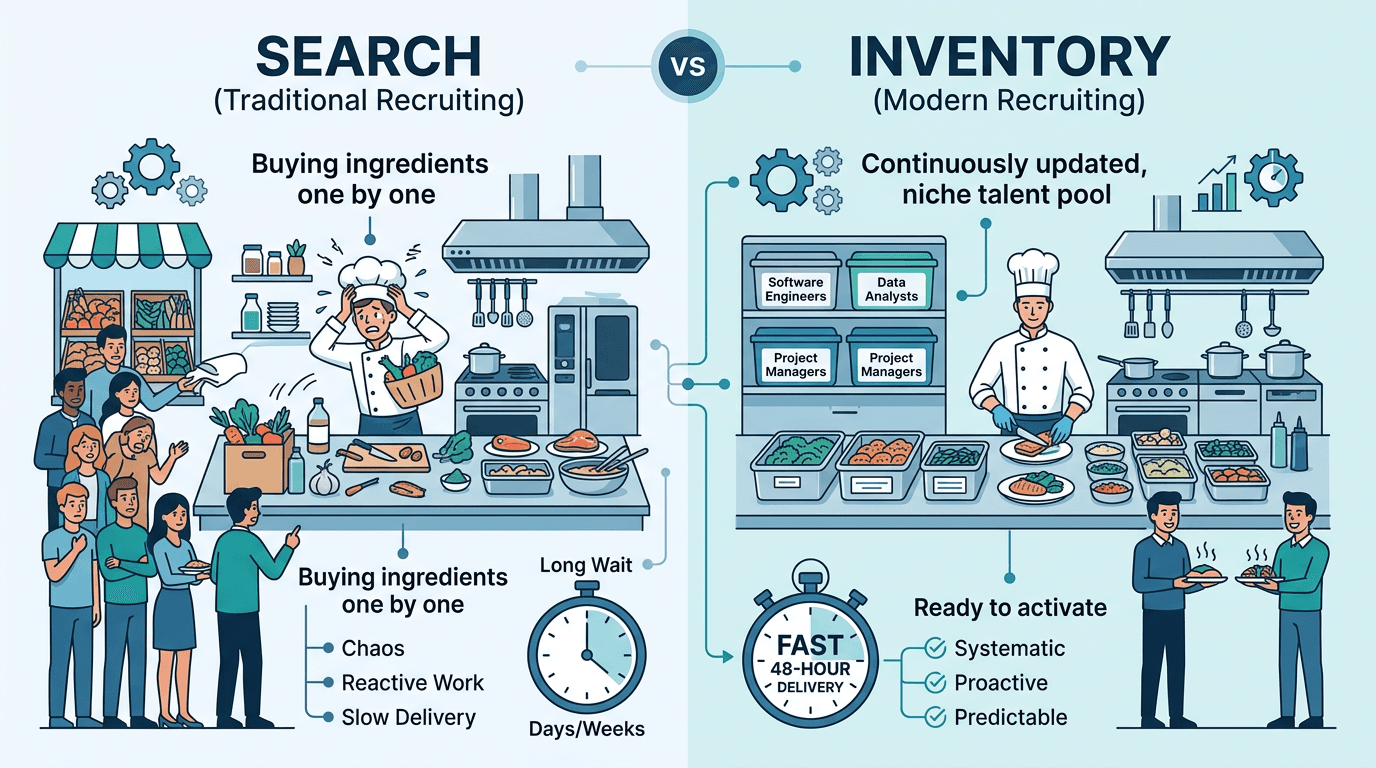
The difference between reactive sourcing and building a proactive candidate inventory.
It’s the difference between:
- a restaurant that buys ingredients one by one during dinner rush
- a restaurant that preps ingredients and runs service like a machine
In recruiting, “inventory” isn’t people sitting on a shelf.
It’s something more elegant:
a continuously updated, niche talent pool that is already segmented, enriched, and ready to activate.
Why 48-hour delivery is becoming the new standard
In 2026, speed isn’t just nice.
Speed is the product.
Three reasons:
1) Great candidates move faster
High-quality candidates don’t wait around.
They take calls, get offers, and disappear.
2) Clients expect instant response
They’ve been trained by SaaS.
They expect dashboards, status updates, and responsiveness.
3) Direct sourcing is everywhere
Your client can run a LinkedIn search, too.
If your value is “we can search,” your value is fragile.
Agencies win now by being the first to deliver credible candidates.
The 48-hour agencies do one thing first: build a living shortlist machine
The winning agencies treat their niche like a system.
When they get a new role, they don’t ask:
“Where do we find candidates?”
They ask:
“Which segment of our pool do we activate?”
That only works if they’ve already done the foundational work:
- define the niche precisely
- build micro-pools (clusters)
- keep data current
- score candidates for fit and reachability
- maintain warm relationships over time
This is the part most agencies skip.
They treat every role like a fresh hunt.
And fresh hunts are slow.
The hidden reason agencies are slower than they think
Founders often blame the market.
But the real slowdown is internal:
- recruiters rebuilding lists from scratch
- messy data
- inconsistent screening
- outreach templates that don’t match the niche
- no system for keeping candidates warm
In other words:
your bottleneck is not talent scarcity. Your bottleneck is process scarcity.
What “inventory” looks like in a recruiting agency
Let’s make it concrete.
A talent inventory system is not one giant list.
It’s micro-pools that match the roles you actually place.
Example (Cloud / DevOps niche):
- SREs (Linux + on-call leadership)
- Kubernetes platform engineers
- DevOps engineers (CI/CD + IaC)
- Staff-level cloud architects
- Team leads / managers (hands-on + leadership)
Each micro-pool is:
- refreshed weekly
- enriched (current role, company, location, skills)
- tagged by real signals (seniority, stack, domain)
- scored for fit + reachability
So when a role appears, you don’t “start.”
You filter, score, and activate.
The 4-part 48-hour delivery playbook
Here’s the pattern agencies use when they consistently deliver in 48 hours:
Step 1: Activate the right micro-pool
Not “search the whole world.”
Activate the cluster that best matches the role.
Step 2: Auto-rank candidates for fit
Use structured data + AI extraction to rank candidates quickly.
This eliminates hours of manual scrolling.
Step 3: Outreach that matches the cluster
The message differs by segment.
A Principal Engineer cares about different things than a Senior.
An SRE cares about different things than a DevOps.
Generic outreach kills speed.
Step 4: Tight follow-up loops
Fast agencies do not “wait.”
They run:
- follow-up sequences
- scheduling automation
- pipeline status updates
Speed is a system.
The ‘wow’ part: you can build this without hiring more recruiters
Most founders assume faster delivery requires more headcount.
But in practice, the opposite is often true.
When you build an inventory system:
- recruiters stop wasting time rebuilding lists
- quality becomes consistent
- shortlists become predictable
- you can take more roles with the same team
That’s why the agencies that embrace this are quietly increasing placements while others feel stuck.
A quick self-check: are you running search or inventory?
If you want to know which mode you’re in, answer these:
- Can you produce a shortlist in 24 hours without fresh LinkedIn searches?
- Are your candidate records refreshed weekly?
- Do you have micro-pools per role type (not one giant database)?
- Can a new recruiter ramp up quickly because the system exists?
If most answers are “no,” then every new role will feel like starting over.
How we implement this in the Talent Pool Ramp-Up Sprint
This is the purpose of our Talent Pool Ramp-Up Sprint.
Outcome:
A living, niche talent pool that updates automatically and can be activated immediately.
What we build with you:
- your pool architecture (micro-pools)
- data ingestion from the sources you already use
- enrichment + weekly refresh loops
- AI extraction of skills + structured fields
- candidate scoring for fit and reachability
- a simple dashboard your team uses daily
The deliverable is not “AI.”
The deliverable is speed you can repeat.
Why this leads to more placements
Speed changes the economics of your agency:
- you respond before competitors
- clients trust you more
- candidates engage sooner
- deals close faster
And when delivery becomes consistent, your business becomes scalable.
Not by hiring more recruiters.
By building a recruiting machine.
Want to see how fast you could deliver in your niche?
If you run a recruiting or staffing agency and want to build a 48-hour shortlist capability, let’s map it.
On a call we’ll:
- pick the best niche micro-pool to build first
- identify the data sources you already have
- outline what the Talent Pool Ramp-Up Sprint would implement